
For as long as I can remember, my grandfather had said he was dying.
He’d declare this loudly, marking out milestones for himself. First he said he wouldn’t live to see me pass my PSLE and graduate from primary school. The goalpost then shifted to finishing my O Levels, then to my graduation from university and my return from New Zealand, then the completion of my Masters, then finally, my marriage. (My younger brother, too, was presented with his own set of markers.)
He once said this in front of a couple of junior doctors, who looked at me with mild alarm. “He’s been saying that since I was 7,” I replied. I was in my mid-20s then.
“Well… I’ll be right one day,” my granddad quipped with a shrug.
Towards the end of his life he stopped making such comments, partly because he was sometimes too muddled to be able to crack such morbid jokes, and partly because it probably didn’t need to be said anymore. Instead, his comments on death—when he was lucid enough to make them—were clear and serious.
“I don’t want any more procedures,” he said on the day the hospital doctors suggested inserting a feeding tube to help with his nutrient intake. “Enough is enough. I’m 96 years old; I’ve had a long life. I love you all, I don’t want you to feel bad. This is my decision.”
“I just want to go peacefully,” he said during another visit. “If the time comes, I don’t want them to do any more. You must make sure, because you are my bravest girl.”
He’d kept mixing my mother and I up during that conversation, so I wasn’t entirely sure which one of us he’d meant to say that to. In the early hours of 8 May 2021, his two bravest girls were called to the hospital, but not quickly enough to say goodbye. We’d missed him by mere minutes, which, I guess, was very much in character. He always found it so hard to wait for anyone. If I said I’d go by at 5pm for dinner, he’d be calling by 5:01pm to ask why I wasn’t there yet.
For much of the past week, my mum and I took turns to spend the night with him, until the latest Covid-19 restrictions kicked in on the 6th. During those nights, I experienced a role reversal. All through primary school he’d been the one to wake me and make me breakfast before the school bus arrived; now, it was my turn to feed him water, respond to his questions, and find him his little handheld flashlight.
“You know, from the back, you look just like my mother,” he said approvingly on the last night I kept him company. I took it as a great compliment, because he’d always spoken of his mother, who died when he was around 13 years old, with such fondness.
Then came the very Kong Kong-like reminiscence: “She was very fat, though. She was so lovable! A wonderful cook, and so good at music, and at night we could roll on her lap, because there was so much meat.”
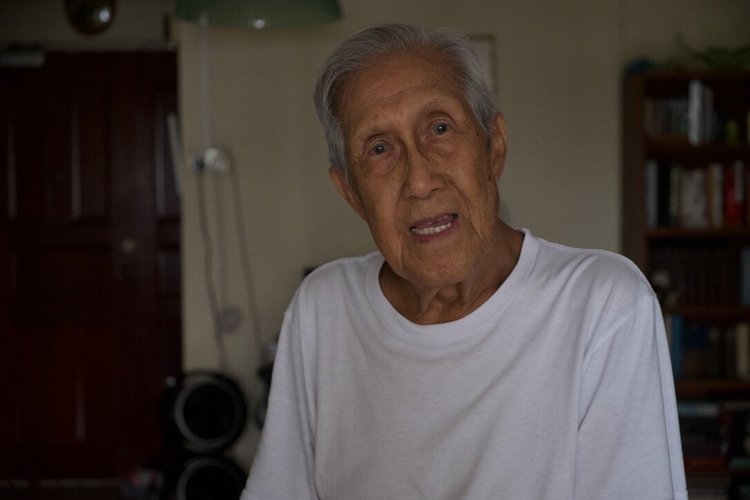
Such moments were flashes of my grandfather as he was; humorous, irreverent, not much bothered by niceties and small talk. He was an independent soul, going about his own business by himself well into his 80s and even in his early 90s.
“The nurses are not very well trained these days,” he’d complained to me over the phone once, when he was in his late-80s. “I came in to A&E to tell them I think I’ve had a stroke, and no one believes me!”
“Huh? How did you get to A&E?!”
“I took the bus!”
“And how did you call me?”
“I can remember your number!”
“Kong Kong, you see why the nurses don’t think you’ve had a stroke?” Even he’d laugh at that.
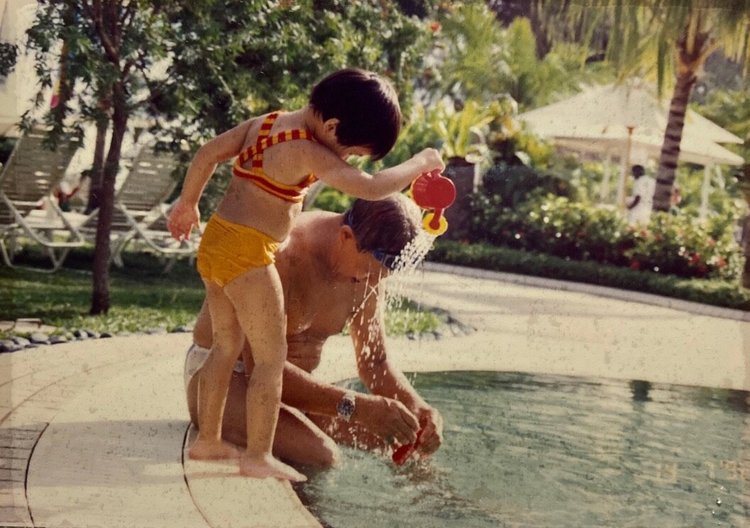
I have so many such anecdotes of my stubborn, funny Kong Kong. In fact, some of my favourite childhood memories aren’t even my memories at all, but memories of my granddad telling them back to me. Like how he used to pick me up from my parents’ in the mornings after they’d gone to work, and how I’d insisted on stopping at McDonalds for hotcakes every time, because they were the closest thing I could find to the pancakes I’d seen on American TV shows. “We ate hotcakes until hotcakes were coming out of my ears!” he’d said. But he still ate them.
Or the time, even further back, when he’d take me on walks in my stroller, singing songs to me until I fell asleep. “And then I’d be there, singing to myself like an idiot.” Once, he stumbled and tripped on a step, tipping the stroller over. The way he told it, he’d heroically twisted his body to cushion my landing, and I ended up on top of him. I’d apparently, very ungratefully, laughed my head off.
Growing up, we never talked politics. But after I started writing about Singapore politics as an adult, my granddad would swing between complaining about the government and calling me to say, “Be careful of what you write!” His age didn’t stop him from learning how to get online, after which he’d follow my blog and read all my posts. He even got himself on Facebook to follow me and other news sources. He never added a profile photo, though. When I asked why, he said, “I’m so handsome, what if lots of people fall in love with me?”
In 2018, he had a bad reaction to some pain medication that a hospital doctor gave him, and went on a massive trip for three days. My family thought he was on his last legs then; I was away for work and was summoned home. But the medication was wearing off by the time I got back. A clear sign that he was reverting to his old self: the second day I was back, he turned his gaze to the newspapers on offer in the ward. “The Straits Times,” he suddenly said.
“Yah, Kong Kong? What about The Straits Times? You want to read it?”
“It’s a shit paper, isn’t it.”
The nurse was rather taken aback, and dropped his voice. “Uncle… actually I agree with you lah, but at work cannot say this kind of thing.”

In 2014, I brought Kong Kong along to the 60th anniversary of the May 13 student movement against the National Service Ordinance passed by the British colonial government. My English-educated granddad didn’t quite follow all that was said by the largely Chinese-educated former student activists, but pointed to Dr Poh Soo Kai, who’d been a founder of the University of Malaya’s Socialist Club, and an editor of their paper Fajar. Dr Poh, along with seven other editors, were charged by the British government for sedition in 1954. “I went to watch every day of the Fajar [sedition] trial,” he suddenly said. He’d never told me that before. “But I wasn’t in Singapore when the May 13 thing happened.”
“Where were you?”
“I agreed to go to Christmas Island to teach.”
“Huh, why?”
“It seemed like fun. But I was only there for one year.”
“Why?”
“Not that fun.”
I’ve never fact-checked these yarns, and certainly the details of some stories are fuzzy, like his tale of how his father, a clerk, had hidden the key to the company safe from the Japanese before returning it, like a bloody honest hero, to his employers at the end of the war. Every time Kong Kong told the story, the amount of money in the safe seemed to increase. We’d sometimes joke that he was accounting for inflation, but I think what was most important to him was that it was a damn good story, and he had fun telling it.
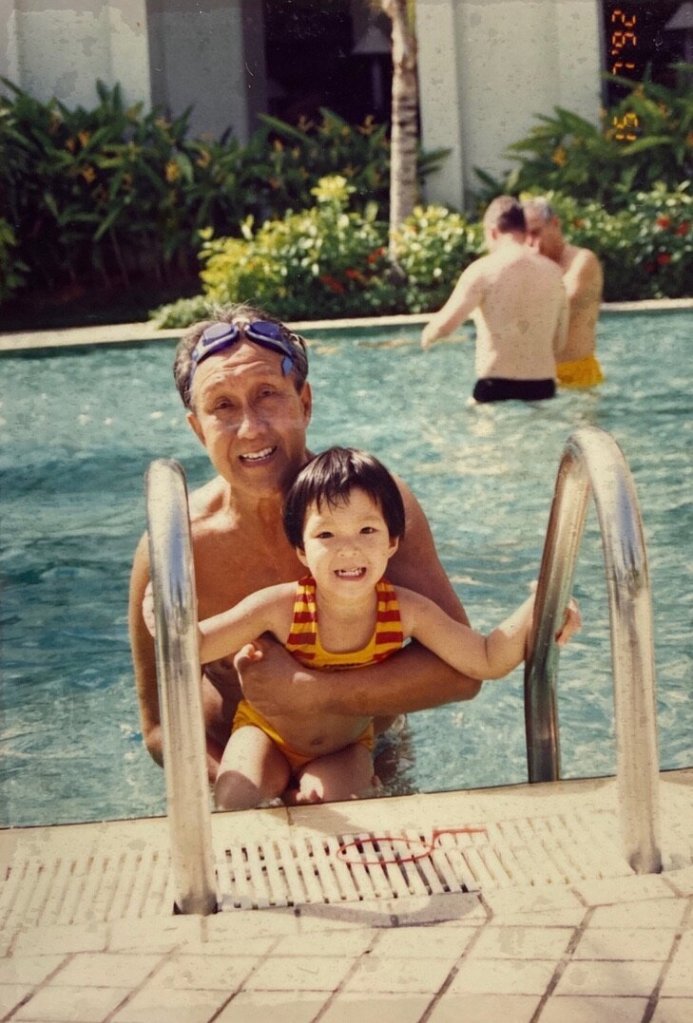
I could go on for much longer recounting all these memories of Kong Kong. I’m writing them down because this is how he should be remembered: a kid who stuck rattan canes through tin lids so he could pretend he was the swashbuckling Errol Flynn, the Robin Hood (or Tarzan) of Everitt Road in Katong. The teenager who was ordered by the Japanese occupiers to bow, but who greeted them with “ohaiyo-gosok-my-arse” as a cheeky act of resistance. The young man who learnt the violin and played for homesick Japanese soldiers, who then gave him lots of offal to take home and make curry, feeding his family and neighbours through the wartime shortages. The teacher who went to Christmas Island to teach and get drunk on the Irish headmaster’s eye-watering moonshine. The granddad who’d do anything for his grandkids, including queuing for hours to buy the new Halo game. The indefatigable old man who, after hurting himself while trying to leap over a longkang, waited till he’d healed up before going back to try again, just to prove a point (he succeeded the second time).
I remember his head-strong, hot-tempered, mischievous, and loving ways with fondness, exasperation, and resignation. I know how he’d have responded to this mix of emotions: a shrug of his shoulders, a cheeky grin, a spreading of his hands as if to say, “What to do? I’m just like that.”
And he was.
Goodbye, my precious Kong Kong. We’ve had a bloody good time.

 Kirsten Han